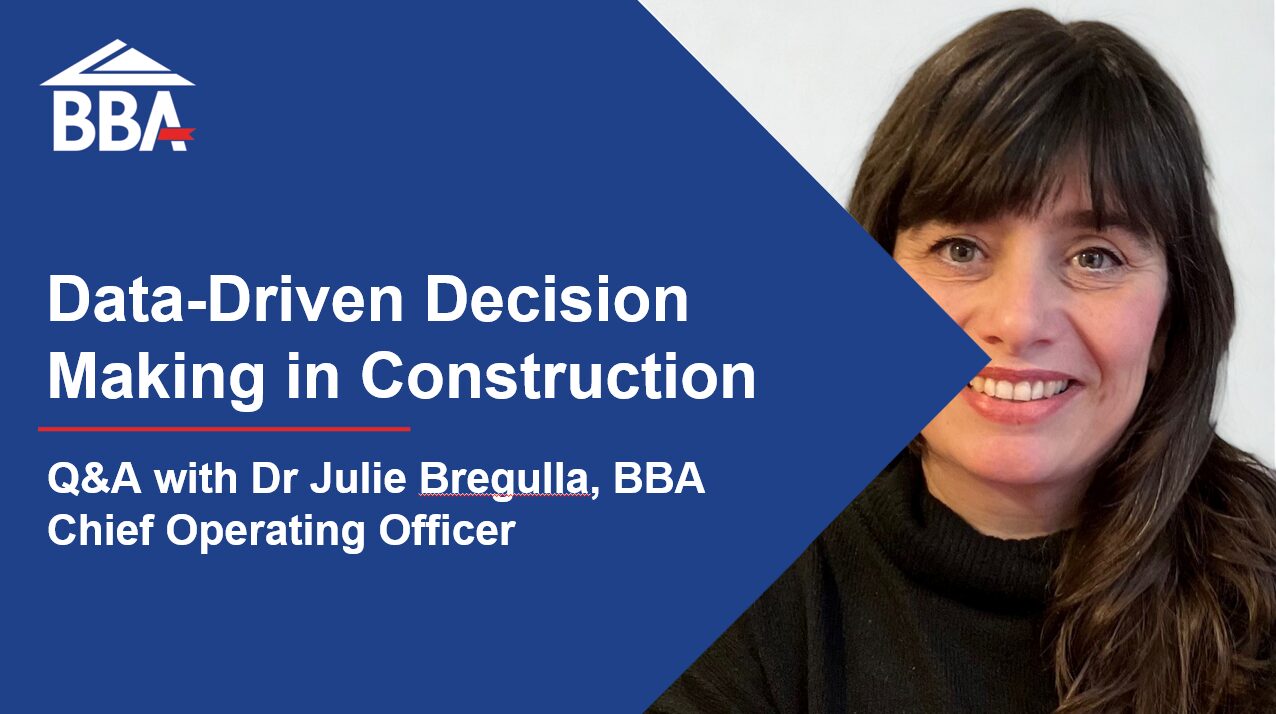
How can the construction industry unlock the full potential of data? What role does certification play in creating a common language for safer, smarter decision making?
In this interview, Julie Bregulla, Chief Operating Officer at the British Board of Agrément, shares deep insight into why data matters more than ever, and how the BBA is helping shape a more reliable, connected future for the sector.
Video: Watch the full interview below:
A Career at the Intersection of Technical Excellence and Industry Change
Julie joined the BBA at the end of 2023, bringing more than 20 years of experience in the testing, inspection and certification (TIC) sector. Her role spans both operational leadership and technical excellence, giving her a unique viewpoint on how data, regulation and product performance intersect.
Despite being relatively new to the BBA, Julie is deeply familiar with the needs of manufacturers, designers, insurers, architects and the entire construction supply chain.
The Agrément Certificate: A Reliable, Consistent Language for the Industry
One of the core themes Julie highlights is the continuing importance of the BBA Agrément Certificate as a trusted, structured source of product performance data.
For manufacturers, a certificate becomes relevant the moment their product is ready for wider market engagement. It documents:
- Whether the product meets minimum regulatory requirements
- Additional performance features that matter to designers and specifiers
- Key technical data, expressed in a clear, consistent, comparable format
This consistency is what turns product information into usable, reliable data for stakeholder decision making.
Julie describes the certificate as a “common language” for the construction industry. One that supports architects, designers, insurers and contractors in understanding exactly how a product performs, under what conditions, and to what standard.
Why High Quality Data Matters More Than Ever
Construction generates huge quantities of data throughout an asset’s lifecycle; design, specification, installation, maintenance, refurbishment and beyond. But as Julie notes, “you can have lots of data and still be information poor.”
The challenge is not the volume of data, but:
- How it is stored
- How it flows between systems
- How stakeholders interpret it
- How reliably it reflects product performance
- Whether it can be used confidently for high‑stakes decisions
Other industries, from pharmaceuticals to consumer technology, have already realised massive productivity gains from centralised, interoperable data. Construction is on the cusp of the same transformation.
Building Trust Through Verified, High Stake Data
All data in construction has the potential to be high‑stake. Decisions influence:
- Building safety
- Compliance
- Performance
- Long-term asset management
That makes the accuracy, clarity and usability of data essential.
Julie stresses the importance of:
- Competence: Data should be used by suitably qualified professionals
- Transparency: Users should understand what data represents — and its limitations
- Continuity: Data must remain meaningful throughout an asset’s lifecycle
- Verification: Independent assessment underwrites the reliability of the data
This is why the BBA’s role as a trusted, impartial certification body remains so critical.
AI, Interfaces and the Future of Data in Construction
Artificial Intelligence offers enormous potential, but also significant challenges. While AI can appear to give fast, credible answers, Julie highlights the risk of misinterpretation and the need for competent oversight. Data must be used responsibly, with:
- Clear benchmarking
- Honest communication of limitations
- Well-designed interfaces that prevent misuse
- Industry‑wide collaboration across data owners
Ultimately, the path forward requires a shared effort. No single organisation can create a full picture in isolation.
A Shared Responsibility for Better Data
From the moment a manufacturer chooses to have their product independently assessed, a voluntary but valuable investment, the responsibility for maintaining accurate product information becomes co‑owned by the manufacturer and the BBA.
Julie reinforces that the BBA sees itself as a caretaker of this data:
- Ensuring it is accurate
- Maintaining its relevance
- Presenting it in a clear, meaningful format
- Working closely with stakeholders to understand how they use it
Collaboration is the key to making data more powerful across the industry.
Creating a Future Where Data Drives Better Decisions
The construction sector stands at a pivotal moment. With unprecedented regulatory change and increasing demand for transparency, the need for trustworthy, accessible, and well‑structured data has never been greater.
The BBA is committed to supporting this future, not only through certification, but through deeper engagement with industry partners to help create:
- A common digital language
- Better interfaces
- Stronger data continuity
- More confident, informed decision‑making
As Julie summarises, “It is our duty to provide information in a way that allows people to make good, valued decisions.”
Share This Story, Choose Your Platform!
Related News
How can the construction industry unlock the full potential of data? What role does certification play in creating a common language for safer, smarter decision making?
In this interview, Julie Bregulla, Chief Operating Officer at the British Board of Agrément, shares deep insight into why data matters more than ever, and how the BBA is helping shape a more reliable, connected future for the sector.
Video: Watch the full interview below:
A Career at the Intersection of Technical Excellence and Industry Change
Julie joined the BBA at the end of 2023, bringing more than 20 years of experience in the testing, inspection and certification (TIC) sector. Her role spans both operational leadership and technical excellence, giving her a unique viewpoint on how data, regulation and product performance intersect.
Despite being relatively new to the BBA, Julie is deeply familiar with the needs of manufacturers, designers, insurers, architects and the entire construction supply chain.
The Agrément Certificate: A Reliable, Consistent Language for the Industry
One of the core themes Julie highlights is the continuing importance of the BBA Agrément Certificate as a trusted, structured source of product performance data.
For manufacturers, a certificate becomes relevant the moment their product is ready for wider market engagement. It documents:
- Whether the product meets minimum regulatory requirements
- Additional performance features that matter to designers and specifiers
- Key technical data, expressed in a clear, consistent, comparable format
This consistency is what turns product information into usable, reliable data for stakeholder decision making.
Julie describes the certificate as a “common language” for the construction industry. One that supports architects, designers, insurers and contractors in understanding exactly how a product performs, under what conditions, and to what standard.
Why High Quality Data Matters More Than Ever
Construction generates huge quantities of data throughout an asset’s lifecycle; design, specification, installation, maintenance, refurbishment and beyond. But as Julie notes, “you can have lots of data and still be information poor.”
The challenge is not the volume of data, but:
- How it is stored
- How it flows between systems
- How stakeholders interpret it
- How reliably it reflects product performance
- Whether it can be used confidently for high‑stakes decisions
Other industries, from pharmaceuticals to consumer technology, have already realised massive productivity gains from centralised, interoperable data. Construction is on the cusp of the same transformation.
Building Trust Through Verified, High Stake Data
All data in construction has the potential to be high‑stake. Decisions influence:
- Building safety
- Compliance
- Performance
- Long-term asset management
That makes the accuracy, clarity and usability of data essential.
Julie stresses the importance of:
- Competence: Data should be used by suitably qualified professionals
- Transparency: Users should understand what data represents — and its limitations
- Continuity: Data must remain meaningful throughout an asset’s lifecycle
- Verification: Independent assessment underwrites the reliability of the data
This is why the BBA’s role as a trusted, impartial certification body remains so critical.
AI, Interfaces and the Future of Data in Construction
Artificial Intelligence offers enormous potential, but also significant challenges. While AI can appear to give fast, credible answers, Julie highlights the risk of misinterpretation and the need for competent oversight. Data must be used responsibly, with:
- Clear benchmarking
- Honest communication of limitations
- Well-designed interfaces that prevent misuse
- Industry‑wide collaboration across data owners
Ultimately, the path forward requires a shared effort. No single organisation can create a full picture in isolation.
A Shared Responsibility for Better Data
From the moment a manufacturer chooses to have their product independently assessed, a voluntary but valuable investment, the responsibility for maintaining accurate product information becomes co‑owned by the manufacturer and the BBA.
Julie reinforces that the BBA sees itself as a caretaker of this data:
- Ensuring it is accurate
- Maintaining its relevance
- Presenting it in a clear, meaningful format
- Working closely with stakeholders to understand how they use it
Collaboration is the key to making data more powerful across the industry.
Creating a Future Where Data Drives Better Decisions
The construction sector stands at a pivotal moment. With unprecedented regulatory change and increasing demand for transparency, the need for trustworthy, accessible, and well‑structured data has never been greater.
The BBA is committed to supporting this future, not only through certification, but through deeper engagement with industry partners to help create:
- A common digital language
- Better interfaces
- Stronger data continuity
- More confident, informed decision‑making
As Julie summarises, “It is our duty to provide information in a way that allows people to make good, valued decisions.”
Share This Story, Choose Your Platform!
Related News
Get in touch
Please complete the form below and we will contact you as soon as possible.
To help us to respond to your inquiry as quickly as possible, we have put a handy list of our services below.